Commentary by Steven Hoffman
Take Action to Defeat the DARK Act...Before it's Too Late
If you are like more than 90% of Americans who want food produced with GMOs to be clearly labeled, then call your U.S. Representative TODAY at 888.754.9091 and tell them to vote AGAINST the DARK Act (S.764).
BOULDER, CO (July 13, 2016) – The Biotech industry scored a major victory on July 7, when the Senate passed S.764, the bill known as the DARK Act (because it would Deny Americans the Right to Know about GMOs). The bill threatens to kill Vermont’s newly enacted mandatory GMO labeling law in favor of an ambiguous federal law full of huge loopholes that critics claim favor corporations over consumers.
The Senate bill S.764 - pushed through by politicians supported through big contributionsfrom the pesticide, biotech and industrial agriculture lobbies - now goes back to the House of Representatives for a fast track vote as soon as THIS WEEK before Congress takes its summer recess on July 15.
If passed, the DARK Act could be on President Obama’s desk for signing before summer recess, denying Americans forever the right to know, in plain English, if their foods were made with genetic engineering.
TAKE ACTION: Call your U.S. Representative at 888.754.9091 to tell him or her to vote against the DARK Act (S.764).
Here are some suggested talking points you can use when you call:
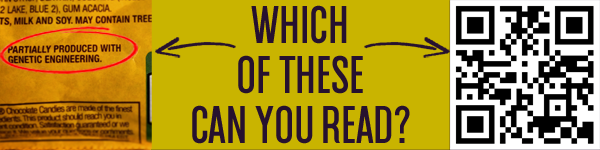
- S.764 would kill Vermont’s law that requires labeling of GMO foods with plain English on-pack disclosure, such as ‘produced with genetic engineering.’
- Vermont's law is working; GMOs are being labeled.
- Food prices are staying the same.
- Nothing has changed at the grocery stores in Vermont and the labels are being used nationwide.
- S.764 would hide information about GMOs behind QR codes. This discriminates against people without smart phones, especially elderly, rural, and low-income people, as well as people of color.
- S.764’s definition of “bioengineered” exempts nearly all GMOs from labeling.
- Even House Agriculture Committee Chairman Mike Conaway says the “bill is riddled with ambiguity and affords the Secretary [of Agriculture] a concerning level of discretion.”
We can stop the DARK Act this time.?? Here's how:
Democrats Won't Be Fooled Twice — In 2015, the House passed H.R.1599, an earlier version of the DARK Act. However, among the 45 Democrats who voted for the DARK Act in 2015, there were a number who did so because they were told that mandatory GMO labeling would cause food prices to increase, despite evidence to the contrary, and that a patchwork of state laws would hamper interstate food commerce.
Yet, now that Vermont’s law has taken effect, we have proof that GMO labels have no impact on food prices. Most of the major U.S. food companies are labeling their GMO foods as “produced with genetic engineering” and not one has said that this imposes a significant cost.
The patchwork of state laws problem doesn’t exist, as no other state law has gone into effect, let alone one that would require something different from Vermont’s “produced with genetic engineering” language.
It is very unlikely that any Democrat concerned about low-income people’s access to food could vote for S.764, which takes the very most expensive and discriminatory option for food labels: QR code SmartLabels that can’t be scanned without a smart phone, internet access and downloaded software.
Plus, only 16% of Americans have ever scanned a QR code for any reason, according to the research firm The Mellman Group.
Almost three quarters of people over the age of 65, half of people living in rural areas, and half of those making less than $30,000 a year lack smart phones, reported Consumers Union. “QR code labeling discriminates against the poor, minorities, rural populations, and the elderly,” says Andrew Kimbrell, executive director at Center for Food Safety. Even if you have a smart phone, he noted, QR codes are difficult to scan and cell reception isn’t always reliable, so you may not be able to connect to the website in the moment you want information on a particular food.
S.764 Discriminates Against Lower Income People — People of limited means care as much about what they eat as the wealthy. S.764 allows essential information about our food to be hidden behind what amounts to a pay-wall.
Samantha McDaniel explains what this would mean for lower income citizens served by her Washington, DC-based Healthy Babies Project:
“I work with teen moms and a lot of them are from very under-privileged neighborhoods with low incomes. When I take them shopping to teach them how to buy healthy, non-GMO food it is already challenging enough. They would never use a smart phone to scan a QR code or go to a website like bill S.764 would require them to do because most can't afford a smart phone. It's also dangerous to be looking at a phone when you have a baby in the cart or a toddler running off in a public place with possible predators nearby. They would not use their cell phone minutes because they have Pay-As-You Go phones and can't afford to use up their minutes on calling food companies.”
Republicans Are Split — While most Republicans have supported the DARK Act, Republican legislators who consistently adhere to free market, small government, and states’ rights principles are opposing federal action on GMO labels.
And their ranks are growing. ??A conservative think-tank, the Heritage Foundation, has come out against S.764. Its lobbying arm warned, “Heritage Action opposes S.764 and will include it as a key vote on our legislative scorecard.”
House Agriculture Committee Chairman Mike Conaway said that he would support the bill, but damned it with faint praise. In a statement he wrote, "After spending the past week and a half studying the legislation and meeting with agricultural producers, along with a variety of other stakeholders, I have come to the conclusion that the Senate bill is riddled with ambiguity and affords the Secretary [of Agriculture] a concerning level of discretion."
If Rep. Conaway doesn't like the DARK Act, think how pro-GMO labeling advocates feel.
Please let your Representative know how problematic this bill is.?? Tell them that Vermont's law is working.
TAKE ACTION: Call your U.S. Representative at 888.754.9091 to tell him or her to vote against the DARK Act (S.764). For more information, visit here.
# # #
Thanks to information and resources shared by Organic Consumers Association
Graphic: Vermont Right to Know GMOs
Comments