Story at-a-glance −
- An industry-funded study claims that diet soda drinkers lose weight faster than those who don’t drink ANY soda at all
- The study comes on the heels of rapid reductions in diet soda sales. Last year, diet Coke and diet Pepsi both dropped by nearly seven percent
- Research over the last 30 years has repeatedly shown that artificially sweetened no- or low-calorie drinks and other “diet” foods tend to stimulate your appetite, increase cravings for carbs, and stimulate fat storage and weight gain
- Studies have also linked diet drinks and artificial sweeteners to a number of other, more serious health hazards, including increased risk of stroke and cancer
- Artificial sweeteners trick your body into thinking that it’s going to receive sugar (calories), but when the sugar doesn’t arrive, your body signals that it needs more, which results in carb cravings
By Dr. Mercola
Do you believe that drinking diet soda will allow you to "have your cake and eat it too" while still controlling your weight, or even shedding a few pounds? This is certainly what the soda industry wants you to believe.
Last year, Coca-Cola Company rolled out an ad campaign encouraging people to unite in the fight against obesity. The ads drew fire from consumers, consumer advocates, and obesity experts1, 2 alike.
Most people saw the campaign as little more than an effort in damage control, considering the overwhelming evidence linking soda consumption to obesity.
Soon thereafter, Coca-Cola Co. launched another ad campaign, this time assuring you that diet beverages containing the artificial sweetener aspartame are a safe alternative to regular soda.3
Now, the soda industry has taken their propaganda to the next level by publishing a study that claims to confirm what the industry has been saying all along—that drinking diet soda will help you lose weight.4, 5
Actually, the industry-funded trial claims diet soda drinkers lose weight faster than those who don't drink ANY soda at all! Talk about going for broke. As reported by Time Magazine:6
"The small study, funded in part by the American Beverage Association, divided 300 diet soda drinkers into two groups. One group could go on drinking the sweet stuff, while the other cut out diet soda entirely.
The study found that the drinkers, with intensive coaching, lost an average of 13 pounds over 12 weeks, while the abstainers, with the same coaching, lost only 9 pounds...
'The most likely explanation was that having access to drinks with sweet taste helps the [artificially-sweetened beverage] group to adhere better to the behavioral change program,' concluded study author Dr. Jim Hill..."
Funding Research—The Best PR Money Can Buy
This study comes like a knight in shining armor, "just in the nick of time," to rescue the soda industry's rapidly dwindling sales.
Growing awareness of the health dangers associated with soda, both regular and diet, has pushed beverage sales into a freefall.7 Sales of carbonated beverages in general fell three percent in 2013, while diet Coke and diet Pepsi both dropped by nearly seven percent.8
Purdue University researcher Susie Swithers9 has strongly criticized the featured study, saying it is "fatally flawed, and leaves us with little science to build on."
For example, it does not contain any information about what the non-diet soda drinkers were actually consuming. While water was suggested as the ideal beverage, did they actually drink water, or did they compensate with fruit juices and regular soda instead?
Susie Swithers' own research shows that diet drinks promote heart problems, and that animals fed artificial sweeteners develop a disrupted metabolic response to real sugar. Earlier this year, she told MedicineNet.com:10
"[Like diabetics], they become hyperglycemic. Their blood sugars go up higher than they should. They also make less of a heart-protective protein. If drinking diet soda interferes with this system, then over the long term you're taking something away that protects your cardiovascular health, and that could be what's contributing to these effects."
Furthermore, with so much evidence weighing against the safety and effectiveness of diet soda, whether for weight loss or any other disease prevention, the featured industry-funded study really offers no scientifically relevant evidence at all that might shift the balance in diet soda's favor. As Swithers notes, "this paper tells us nothing about the long-term health consequences that should be our real focus." What the study CAN do, however, is create media buzz and splashy headlines where the words "science," "study," and "proven weight loss" are favorably combined, and that is worth more than anything a PR firm might cook up.
Industry Funding Dramatically Increases Odds of Favorable Research Results
The misuse of science to further a preconceived commercial agenda is so rampant today that it can be quite tricky to determine what's what. One key factor is to determine who paid for the research, because when industry funds the research, it's virtually guaranteed to be favorable. Quite simply, an independent researcher has far less incentive to come to any particular conclusion—good or bad.
I've previously said that we've left evidence-based decision-making behind, and we're now in an era of "decision-based evidence-making." What I mean by that is that the preferred business model of an industry is created first, followed by "scientific evidence" that has been specifically created to support the established business model.
This is yet another perfect example of this. After two failed marketing campaigns (the latter of which was designed to look like a public service announcement rather than a classic advertisement), the beverage industry turned to "science" in an effort to win back customers.
As I discussed in a previous article, the Calorie Control Council is an association that represents manufacturers and suppliers of low-calorie, sugar-free, and reduced sugar foods and beverages. It is, of course, a staunch defender of aspartame's safety and effectiveness for weight management and diabetic control, and is quick to dismiss any research that suggests otherwise.
The group recently denounced research showing that post-menopausal diet soda drinkers raise their risk of heart attacks and stroke, stating that such findings "do not support the majority of the scientific evidence on the topic, and are at odds with statements from the American Heart Association."11
What many don't realize is that the Calorie Control Council has strong ties to the Kellen Company, which is instrumental in creating and managing industry front groups specifically created to mislead you about the product in question, protect industry profits, and influence regulatory agencies. Unfortunately for anyone who has fallen for the false advertising, diet soda actually tends to promote weight gain, and numerous studies that were NOT funded by industry attest to this.
The List of Studies Refuting 'Diet' Claims Is Long
Research has repeatedly shown that artificially sweetened no- or low-calorie drinks and other "diet" foods tend to stimulate your appetite, increase cravings for carbs, and stimulate fat storage and weight gain. Artificial sweeteners basically trick your body into thinking that it's going to receive sugar (calories), but when the sugar doesn't arrive, your body signals that it needs more, which results in carb cravings. Most people give in to such cravings and end up overeating on other foods and snacks.
This connection between sweet taste alone and increased hunger can be found in the medical literature going back at least two decades. But artificial sweeteners also appear to produce a variety of metabolic dysfunctions that promote weight gain. Here's a sampling of some of the studies published through the years, clearly refuting the beverage industry's claims that diet soda aids weight loss:
Preventive Medicine, 198612 This study examined nearly 78,700 women aged 50-69 for one year. Artificial sweetener usage increased with relative weight, and users were significantly more likely to gain weight, compared to those who did not use artificial sweeteners—regardless of their initial weight. According to the researchers, the results "were not explicable by differences in food consumption patterns. The data do not support the hypothesis that long-term artificial sweetener use either helps weight loss or prevents weight gain."
Physiology and Behavior, 198813 In this study, they determined that intense (no- or low-calorie) sweeteners can produce significant changes in appetite. Of the three sweeteners tested, aspartame produced the most pronounced effects.
Physiology and Behavior, 199014 Here, they found that aspartame had a time-dependent effect on appetite, "producing a transient decrease followed by a sustained increase in hunger ratings."
Journal of the American Dietetic Association, 199115 In a study of artificial sweeteners performed on college students, there was no evidence that artificial sweetener use was associated with a decrease in their overall sugar intake either.
International Journal of Obesity and Metabolic Disorders, 200416 This Purdue University study found that rats fed artificially sweetened liquids ate more high-calorie food than rats fed high-calorie sweetened liquids. The researchers believe the experience of drinking artificially sweetened liquids disrupted the animals' natural ability to compensate for the calories in the food.
San Antonio Heart Study, 200517 Data gathered from the 25-year long San Antonio Heart Study also showed that drinking diet soft drinks increased the likelihood of serious weight gain – far more so than regular soda.18 On average, for each diet soft drink the participants drank per day, they were 65 percent more likely to become overweight during the next seven to eight years, and 41 percent more likely to become obese.
Journal of Biology and Medicine, 201019 This study delves into the neurobiology of sugar cravings and summarizes the epidemiological and experimental evidence concerning the effect of artificial sweeteners on weight.
According to the authors: "[F]indings suggest that the calorie contained in natural sweeteners may trigger a response to keep the overall energy consumption constant. ...Increasing evidence suggests that artificial sweeteners do not activate the food reward pathways in the same fashion as natural sweeteners… [A]rtificial sweeteners, precisely because they are sweet, encourage sugar craving and sugar dependence."
Yale Journal of Biology and Medicine, 201020 This review offers a summary of epidemiological and experimental evidence concerning the effects of artificial sweeteners on weight, and explains those effects in light of the neurobiology of food reward. It also shows the correlation between increased usage of artificial sweeteners in food and drinks, and the corresponding rise in obesity.
Appetite, 201221 Here, researchers showed that saccharin and aspartame both cause greater weight gain than sugar, even when the total caloric intake remains similar.
Trends in Endocrinology & Metabolism, 201322 This report highlights the fact that diet soda drinkers suffer the same exact health problems as those who opt for regular soda, such as excessive weight gain, type 2 diabetes, cardiovascular disease, and stroke.23, 24 The researchers speculate that frequent consumption of artificial sweeteners may induce metabolic derangements.
Comprehensive Review Finds You Gain Weight by Drinking Diet Soda
The 2010 review in the Yale Journal of Biology and Medicine25 is of particular relevance here, as it offers a great historical summary of artificial sweeteners in general, and the epidemiological and experimental evidence showing that artificial sweeteners tend to promote weight gain. It also illustrates that as usage of artificial sweeteners has risen, so has obesity rates—despite all these "diet friendly" products. According to a recent Democrat & Chronicle article,26 "a University of Texas Health Science Center study found that frequent drinkers of diet sodas had waist circumference increases that were 500 percent greater than non-drinkers of diet soda."
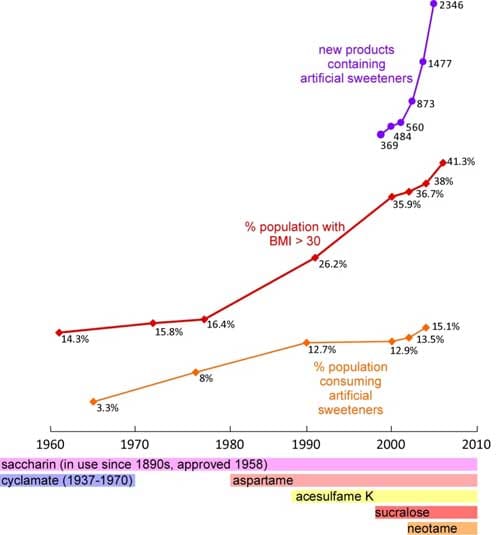
Source: Yale Journal of Biology and Medicine June 8, 2010: v83(2)
According to the author:
"Intuitively, people choose non-caloric artificial sweeteners over sugar to lose or maintain weight...But do artificial sweeteners actually help reduce weight? Surprisingly, epidemiologic data suggest the contrary. Several large scale prospective cohort studies found positive correlation between artificial sweetener use and weight gain.
The San Antonio Heart Study examined 3,682 adults over a seven to eight year period in the 1980s. When matched for initial body mass index (BMI), gender, ethnicity, and diet, drinkers of artificially sweetened beverages consistently had higher BMIs at the follow-up, with dose dependence on the amount of consumption. Average BMI gain was +1.01 kg/m2 for control and 1.78 kg/m2 for people in the third quartile for artificially sweetened beverage consumption."
The review also highlights the 1986 study published in Preventive Medicine27 (also listed above). Again, nearly 78,700 women were included in this American Cancer Society study, and at one year follow-up, 2.7 percent to 7.1 percent more artificial sweetener users had gained weight, when compared to non-users and matched by initial weight. A later study,28 performed in the 1990s, also found that women who regularly used saccharin gained more weight over an eight year period, compared to non-users. The same kind of results are found in studies evaluating the effect of artificial sweeteners in children:
- In one two-year long study,29 which involved 166 school children, increased diet soda consumption was associated with higher BMI at the end of the trial.
- The Growing Up Today Study,30 which included more than 11,650 children aged 9-14, also found a positive association between diet soda consumption and weight gain in boys. Each daily serving of diet beverage was associated with a BMI increase of 0.16 kg/m2.
- The National Heart, Lung, and Blood Institute Growth and Health Study31 included 2,371 girls aged 9-19 for 10 years. Soda consumption in general, both regular and diet, was associated with increase in total daily energy intake.
- Another 2003 study looking at 3,111 children found diet soda, specifically, was associated with higher BMI.32
Diet Soda May Harm Diabetics to Greater Degree Than Sugar
How much evidence do you need before you make up your mind? Will one study showing serious harm make you think twice about drinking diet soda? Will 10... 50... 100 studies bring you to a decision? Besides decimating the claim that diet soda is a useful diet aid, studies have also linked diet drinks and artificial sweeteners to a number of other, more serious health hazards, including increased risk of stroke and cancer. There are in fact hundreds of published studies demonstrating the harmful effects of aspartame... Yet the industry keeps repeating the mantra that "no harmful effects have ever been proven."
After hearing it so many times, many actually believe this to be true. Browsing through the medical literature, however, will quickly reveal such claims to be a stretch, if not an outright lie. For starters, researchers have demonstrated that aspartame worsens insulin sensitivity to a greater degree than sugar. This is a serious blow for diabetics who follow the recommendation to switch to diet sodas to manage their condition. It's worth noting that the study in question used a dosage of aspartame that approximates the ADI for aspartame in the US (approx. 50 mg/kg body weight), and not only was aspartame found to decrease insulin sensitivity compared to controls, it also wrought havoc on brain function!
Studies Also Warn of More Serious Health Hazards
Two years ago, preliminary research warned that diet soda appears to dramatically increase your risk of stroke. The researchers found that people who drank diet soft drinks on a daily basis were 43 percent more likely to have suffered a vascular event, including a stroke. This association persisted even after controlling for other factors that could increase the risk, such as smoking, physical activity levels, alcohol consumption, diabetes, heart disease, dietary factors, and more. According to the authors:
"This study suggests that diet soda is not an optimal substitute for sugar-sweetened beverages, and may be associated with a greater risk of stroke, myocardial infarction, or vascular death than regular soda."
Of even greater concern are the studies suggesting a link between artificial sweeteners and cancer—the number one killer of Americans under the age of 85:33
- One lifetime feeding study published in 201034 found that aspartame induced cancers of the liver and lung in male mice. It was also carcinogenic in male and female rats.
- The most comprehensive and longest human study — spanning 22 years — that has ever looked at aspartame toxicity was published in 2012. It evaluated the effect between aspartame intake and cancer, and the researchers found a clear association between aspartame consumption and non-Hodgkin's Lymphoma and leukemia.
FDA Approval Means Little When It Comes to Ascertaining Safety
As previously noted by Dr. Janet Hull,35 many tend to excuse the negative health effects of aspartame simply because it has received the stamp of approval by the Food and Drug Administration (FDA). "[T]his may not be something the American consumer can actually depend upon anymore," she writes, because "[t]he FDA rules and regulations for the approval of food additives... it has some serious flaws."
As discussed in her article, "Abusing the FDA Approval Process,"36 the FDA requires that the industry do its own research, and actually places the burden of proof on the company making the product. Dr. Hull explains:
"Basically, all the FDA is responsible for is reviewing the summaries of research conducted by the company applying for approval, typically from scientific studies the applicant has pay-rolled. Then, the company presents their reasons why their product should be allowed in the public food supply based on their research. At the very least, the research reports are controversial, and rarely reviewed by independent researchers not related to the industry."
Should you still be confused on this issue, thinking that the buck somehow stops at the FDA, FDA spokesman Theresa Eisenman recently clarified who is ultimately responsible for making sure a food product is safe, stating that:37 "Manufacturers are responsible for ensuring that their food products are safe and lawful..."
But what company would really make a serious effort to find problems with the very products they want to capitalize on? Despite this illogical premise, the FDA trusts corporations to be honest in their research and evaluations. How likely do you think it is that this "honor system" will actually ensure that each product released to market is safe?
When it comes to artificial sweeteners, aspartame in particular, there's no doubt in my mind that the system has protected industry profits at consumers' expense. And we've not seen the last of it. Despite mounting evidence showing that artificial sweeteners as a group have adverse health effects, the FDA has just approved yet another artificial sweetener called Advantame,38, 39 derived from a combination of aspartame and vanillin.
Being 20,000 times sweeter than refined sugar, Advantame is the sweetest artificial sweetener so far. To put this into perspective, aspartame, sucralose, and saccharine range from 200 to 700 times sweeter than sugar. Also, as reported by the LA Times:40
"Like aspartame, advantame contains phenylalanine, which is metabolized with difficulty by people with a rare genetic disorder, phenylketonuria. But because of its intense sweetness, advantame would be used at much lower volumes than is asparatame. As a result, the FDA has declared that it can be safely consumed by those with phenylketonuria."
Are You Ready to Ditch Diet Soda?
When you consume artificial sweeteners, your brain actually craves more calories because your body receives no satisfaction on a cellular level by the sugar imposter. This can contribute to not only overeating and weight gain, but also an addiction to artificial sweeteners. To break free, I recommend addressing any emotional component of your food cravings using a tool such as the Emotional Freedom Technique (EFT).
A version of EFT specifically geared toward combating sugar cravings is called Turbo Tapping. For further instructions, please see the article, "Turbo Tapping: How to Get Rid of Your Soda Addiction." The video below with EFT practitioner Julie Schiffman also demonstrates how to use EFT to fight food cravings of all kinds.
If you still have cravings after trying EFT or Turbo Tapping, you may need to make some changes to your diet. My free nutrition plan can help you do this in a step-by-step fashion. As for safer sweetener options, you could use stevia or Luo Han, both of which are safe natural sweeteners. That said, if you struggle with high blood pressure, high cholesterol, diabetes, or extra weight, then you have insulin sensitivity issues and would likely benefit from avoiding ALL sweeteners.
Last but not least, if you experience side effects from aspartame or any other artificial sweetener, please report it to the FDA (if you live in the United States) without delay. It's easy to make a report — just go to the FDA Consumer Complaint Coordinator page, find the phone number for your state, and make a call reporting your reaction.
Comments