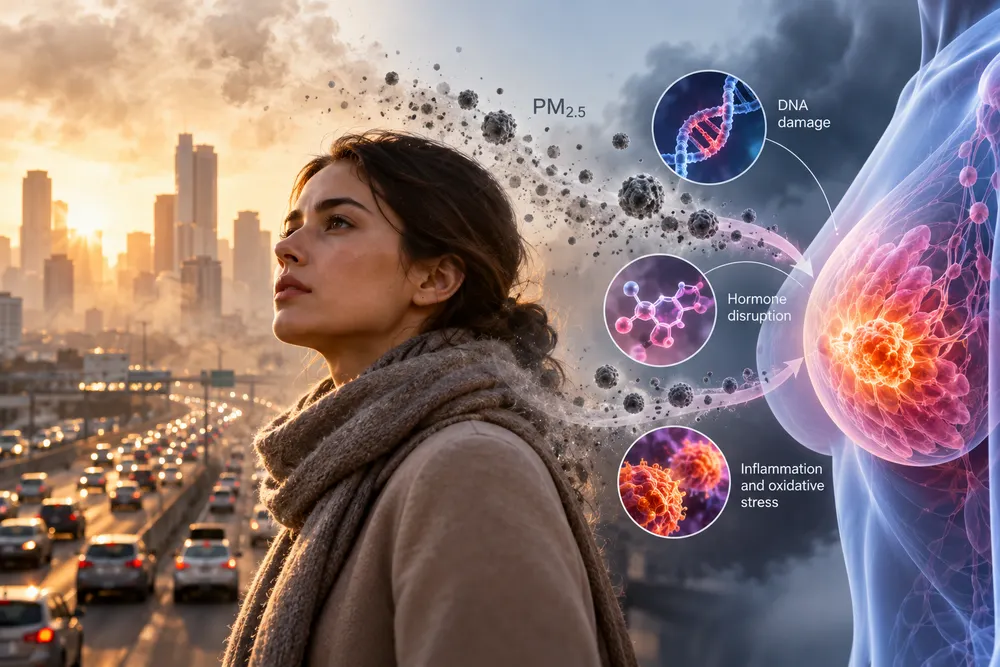
HEALTH & ENVIRONMENT | RESEARCH REVIEW | OCTOBER 2026
New research suggests that long-term exposure to air pollution may be an underrecognized environmental risk factor for breast cancer. Studies involving hundreds of thousands of women have found associations between fine particulate matter, traffic-related pollution, and higher rates of breast cancer, raising important questions about prevention, environmental health, and public policy.
Based on IQAir's article, How Air Quality Affects Breast Cancer, supplemented with findings from the National Institutes of Health (NIH) and peer-reviewed research.
Key findings at a glance
- 8% (NIH study, 2023): Higher breast cancer incidence per 10 µg/m³ increase in long-term PM2.5 exposure
- 3% (Five-cohort study, 2025): Higher overall breast cancer incidence associated with a 10 ppb increase in NO₂
- 28% (California cohort, 2025): Higher breast cancer incidence per 10 µg/m³ increase in PM2.5 in one study
- 28,811 (Five U.S. cohorts): Breast cancer cases included in the pooled research analysis
These are relative associations from observational research, not absolute individual risks. Results use different populations and analytical methods, so they should not be compared as directly interchangeable estimates.
1. What is the relationship between air pollution and breast cancer?
For decades, breast cancer prevention has focused on established factors such as age, inherited genetic variants, reproductive history, alcohol consumption, obesity after menopause, and hormonal exposures.
Scientists are increasingly examining another possible contributor: the quality of the air people breathe throughout their lives.
The IQAir report brings together epidemiological studies from the United States, France, Denmark, and China. Its central argument is that chronic exposure to pollutants may contribute to biological conditions that encourage breast cancer development.
The evidence is particularly relevant to people living near highways, congested traffic corridors, industrial facilities, and communities with persistently elevated pollution levels.
Researchers have observed increased breast cancer incidence in populations exposed to higher concentrations of several pollutants, including fine particulate matter (PM2.5) and nitrogen dioxide (NO₂).
However, an important scientific distinction must be maintained: an association does not automatically establish that air pollution directly caused a particular breast cancer case. Researchers must account for other influences, including socioeconomic conditions, smoking, reproductive history, occupational exposures, and access to medical care.
The accumulated evidence supports concern about air pollution as a potential modifiable risk factor, but it does not justify treating pollution as the sole or primary explanation for breast cancer.
2. Which air pollutants are associated with breast cancer?
The IQAir article identifies several pollutants that may affect breast tissue directly or indirectly.
| Pollutant | Common sources | Potential relevance to breast cancer |
|---|---|---|
| PM2.5 | Vehicle exhaust, combustion, industrial emissions, wildfire smoke | Associated with higher breast cancer incidence in several studies |
| PM10 | Road dust, construction, industrial activity | Studied as a marker of particulate pollution exposure |
| Nitrogen dioxide (NO₂) | Traffic, combustion, gas-burning equipment | Associated with breast cancer incidence in population studies |
| Polycyclic aromatic hydrocarbons (PAHs) | Diesel exhaust, tobacco smoke, incomplete combustion | Some PAHs can damage DNA and disrupt biological signaling |
| Volatile organic compounds (VOCs) | Solvents, fuels, industrial emissions | Certain compounds have carcinogenic potential |
| Black carbon | Diesel engines, coal and other combustion sources | Indicator of combustion-related pollution |
| Arsenic and nickel compounds | Selected industrial emissions and combustion processes | Certain forms are recognized carcinogenic hazards |
Why PM2.5 deserves particular attention
PM2.5 refers to airborne particles with aerodynamic diameters of 2.5 micrometers or less.
These particles are small enough to reach deep into the lungs. Some components of particulate pollution can enter circulation or trigger systemic inflammatory responses.
PM2.5 is not one uniform chemical. It is a mixture whose composition varies with traffic, industrial activity, wildfire smoke, fuel combustion, and other sources.
This matters because different particle mixtures may have different toxicological properties.
3. What do major scientific studies reveal?
NIH study: An 8% increase in breast cancer incidence
In September 2023, NIH researchers reported that higher long-term exposure to particulate air pollution was associated with increased breast cancer incidence.
The research drew on a large U.S. cohort and identified 15,870 breast cancer cases.
For every additional 10 micrograms per cubic meter (µg/m³) of PM2.5 exposure, researchers observed approximately 8% higher breast cancer incidence.
The research also explored long-term exposure patterns, recognizing that cancer can develop over many years and that past exposures may be more relevant than air quality immediately before diagnosis.
Source: National Institutes of Health, September 2023.
2025 U.S. research: Traffic pollution and breast cancer
A study combining five large U.S. prospective cohorts identified 28,811 breast cancer cases.
Researchers examined residential exposure to nitrogen dioxide, PM2.5, and ozone.
They found that each 10-parts-per-billion increase in NO₂ was associated with approximately 3% higher overall breast cancer incidence.
More importantly, the findings varied by tumor subtype and geography. PM2.5 was associated with higher incidence of estrogen-receptor-negative/progesterone-receptor-negative breast tumors and with increased overall breast cancer incidence in the Midwest.
These results suggest that pollution may affect different breast tumor categories differently.
Source: Air Pollutants and Breast Cancer Risk: A Parallel Analysis of Five Large US Prospective Cohorts.
California study: A stronger PM2.5 association
IQAir highlights a 2025 multiethnic cohort study involving more than 58,000 women in California, followed for approximately 19 years.
The reported finding was a 28% increase in breast cancer incidence per 10 µg/m³ increase in PM2.5.
The article also identifies differences across racial and ethnic groups, emphasizing the importance of studying environmental exposures in diverse populations.
However, a larger percentage in one cohort does not necessarily mean pollution is biologically more dangerous in California. Exposure assessment, statistical adjustment, particle composition, and population characteristics can influence study results.
Source: Journal of Clinical Oncology — Multiethnic Cohort Study.
International studies: Similar concerns beyond the United States
The IQAir report also highlights:
- France: Research involving nearly 100,000 women over approximately 21 years reported associations between particulate pollution exposure and breast cancer.
- Denmark: A nationwide study examined 55,745 breast cancer cases and found associations with particulate pollution and NO₂, with particularly notable results for PM2.5.
- China: A Beijing cohort study examined PM2.5 components, including black carbon associated with combustion sources, and their relationships with breast cancer incidence.
These international results strengthen the argument that pollution-related breast cancer risk merits attention beyond any one country's environmental conditions.
4. How might polluted air contribute to breast cancer?
The IQAir article identifies three major biological processes that could help explain the observed relationships.
Potential biological pathways
Long-term exposure to polluted air (PM2.5, NO₂, PAHs and other pollutants) may lead to:
- DNA damage: genetic injury and mutations
- Hormone disruption: altered estrogen signaling
- Inflammation: oxidative stress and cell injury
These pathways represent a possible contribution to breast cancer development. They are plausible biological mechanisms under investigation; this does not establish causation in an individual.
DNA damage and genetic mutations
Some pollutants contain chemicals capable of interacting with DNA. Polycyclic aromatic hydrocarbons, for example, can undergo metabolic activation and form DNA adducts—chemical attachments that may interfere with normal DNA replication and repair.
If damage persists or is incorrectly repaired, mutations can accumulate in genes involved in cell growth and division.
Hormonal disruption
Estrogen influences the growth and development of breast tissue and plays a central role in many breast cancers.
Some environmental chemicals can mimic, block, or interfere with hormonal signaling. Researchers are investigating whether components of air pollution may influence estrogen-related biological pathways and contribute to tumor development.
Chronic inflammation and oxidative stress
Exposure to particulate pollution can promote oxidative stress, a condition in which reactive molecules overwhelm the body's protective systems.
Long-lasting inflammation and oxidative stress may damage cellular components, change the surrounding tissue environment, and influence processes involved in cancer progression.
These proposed mechanisms are supported by broader toxicological research, although the precise contribution of each pathway to pollution-associated breast cancer risk remains uncertain.
5. Does pollution exposure affect different breast cancer types?
An important finding from recent research is that not all breast cancers may respond identically to environmental exposures.
Breast tumors are commonly classified according to whether they express estrogen receptors (ER) or progesterone receptors (PR).
The 2025 five-cohort analysis reported that PM2.5 was associated with a 14% higher incidence of ER-negative/PR-negative tumors for the exposure increment used in the study.
A separate Sister Study analysis, published in November 2025, examined exposure timing and found that NO₂ exposure during earlier years was associated with ER-positive breast cancer and ductal carcinoma in situ (DCIS). The analysis also identified associations between PM2.5 exposure during certain earlier years and ER-negative cancer.
These findings suggest that both the type of pollutant and the timing of exposure may matter.
More research is needed before these observations can guide individual breast cancer risk prediction or screening recommendations.
6. Who may face greater exposure?
Pollution exposure is not distributed equally.
People living near high-traffic roads, shipping facilities, industrial corridors, and combustion-intensive workplaces may experience higher pollutant concentrations.
Exposure can also vary according to housing quality, indoor ventilation, occupation, neighborhood infrastructure, and access to cleaner environments.
The IQAir article emphasizes environmental inequality, noting that some communities face overlapping disadvantages related to pollution, housing, and access to healthcare.
However, differences in measured cancer risk across populations should not automatically be attributed to air pollution alone. Breast cancer outcomes are shaped by multiple biological, social, economic, and healthcare factors.
7. How can people reduce their exposure to polluted air?
Although there is no established guarantee that personal air-cleaning measures prevent breast cancer, reducing harmful air pollution exposure can deliver broader health benefits.
Monitor local air quality
Check daily AQI forecasts and PM2.5 concentrations, particularly during wildfire smoke events, industrial pollution episodes, or periods of heavy traffic.
Improve indoor air filtration
Use appropriately sized HEPA air cleaners or effective HVAC filtration where suitable. Reduce indoor particle sources, including tobacco smoke, and ventilate appropriately when outdoor air is cleaner.
Avoid heavily polluted exercise locations
When practical, select walking and exercise routes away from major traffic corridors, and reduce prolonged outdoor exertion during severe pollution events.
Use suitable respiratory protection when needed
A well-fitting N95 or equivalent respirator can reduce inhalation of airborne particles during high-pollution episodes. It does not reliably protect against all pollutant gases.
Continue recommended breast cancer screening
Air quality precautions do not replace established screening. In the United States, the USPSTF recommends mammography every two years for women aged 40–74 at average risk. People at higher risk should discuss individualized screening with a clinician.
What air pollution levels should we aim for?
The World Health Organization's 2021 guidelines recommend the following pollutant concentrations:
| Measurement | WHO guideline |
|---|---|
| Annual average PM2.5 | 5 µg/m³ |
| 24-hour PM2.5 | 15 µg/m³ |
| Annual average NO₂ | 10 µg/m³ |
These are general health-based air quality guidelines, not breast-cancer-specific safety thresholds.
8. Why government policies matter more than individual precautions alone
The IQAir report stresses that air pollution is ultimately a population-level environmental problem.
Air purifiers and masks can reduce individual exposure, but they cannot eliminate pollution originating from highways, factories, power generation, or other widespread sources.
Effective long-term strategies include cleaner transportation, stronger industrial emission controls, expanded public transportation, improved urban planning, environmental monitoring, and protections for communities disproportionately exposed to pollution.
Reductions in population-wide exposure could potentially lower pollution-associated health risks, although the precise number of breast cancer cases preventable through any particular policy remains unknown.
9. What the IQAir article gets right—and where caution is needed
The article provides a useful overview of evidence connecting air pollution with breast cancer, but several distinctions are important for accurate health reporting.
First, an 8% or 28% relative increase in incidence does not mean an individual's absolute probability of developing breast cancer increases by that many percentage points.
Second, the article suggests that a 3% increase in U.S. breast cancer incidence could represent approximately 9,500 cases when applied to annual national diagnoses. That is a mathematical illustration, not a scientifically established number of cases caused by air pollution. Population exposure distributions and causal assumptions would need to be considered.
Third, PM2.5, NO₂, and black carbon are often related indicators of pollution from shared sources. Associations do not necessarily identify a single chemical responsible for tumor development.
Finally, reducing exposure is a sensible public-health precaution, but scientists have not yet established how much breast cancer risk an individual can eliminate by purchasing an air purifier, wearing a mask, or changing exercise routes.
These distinctions make the article more credible and avoid overstating the existing scientific evidence.
10. Frequently asked questions
Can breathing polluted air cause breast cancer?
Long-term exposure to certain air pollutants is associated with increased breast cancer incidence. Researchers have identified plausible biological mechanisms, but observational studies cannot conclusively establish that polluted air caused an individual case.
Which pollutant has the strongest association with breast cancer?
PM2.5 is among the most extensively studied pollutants, while NO₂ and certain combustion-related pollutants also show associations. The strength of results varies by study, exposure period, population, and tumor subtype.
Does living near a highway increase breast cancer risk?
Living near busy roads can increase exposure to traffic-related pollution. Several studies associate such exposure with breast cancer incidence, although individual risk also depends on many other factors.
Can air purifiers prevent breast cancer?
Air purifiers can reduce indoor particle concentrations when properly selected and used. However, there is currently insufficient direct evidence to conclude that using an air purifier reduces breast cancer incidence.
Is short-term exposure as dangerous as long-term exposure?
Most breast cancer research emphasizes cumulative or historical exposure over years. A short pollution event should not be interpreted as having the same risk as sustained long-term exposure.
Conclusion
A growing body of scientific research suggests that dirty air may contribute to breast cancer risk, adding an environmental dimension to a disease traditionally discussed through genetics, lifestyle, and hormonal factors.
Large population studies have found associations between long-term exposure to PM2.5, NO₂, and higher breast cancer incidence, with emerging evidence of differences across tumor subtypes and exposure periods.
The findings justify further research, stronger air quality protection, and careful efforts to reduce exposure.
The central message is that cleaner air may have benefits that extend beyond respiratory and cardiovascular health—but breast-cancer-specific preventive effects still need stronger causal evidence.
SEO elements for publication
Recommended SEO title:
Meta description:
Suggested URL slug:
Primary target keyword: air pollution and breast cancer risk
Secondary keywords: air quality and breast cancer, PM2.5 breast cancer, dirty air cancer risk, traffic pollution breast cancer, environmental causes of breast cancer, air pollution health effects, air pollution cancer research
Suggested image alt text: Air pollution and breast cancer risk research showing how PM2.5 and traffic-related pollutants may affect women's health.
Additional SEO recommendations
Use the article's current H1 as the principal page heading. Retain the pollutant and research-study sections as H2 headings, and mark up the FAQ section with appropriate semantic HTML. If using FAQ structured data, ensure it accurately represents visible questions and answers; Google generally limits FAQ rich-result eligibility to well-known authoritative government and health websites.
For medical-content credibility, display a publication and review date, identify the author and their qualifications, add a medical or scientific reviewer where possible, and link directly to original research.
Primary sources and further reading
- IQAir — How Air Quality Affects Breast Cancer
- NIH — High Levels of Particulate Air Pollution Associated With Increased Breast Cancer Incidence
- 2025 Five-Cohort Study — Air Pollutants and Breast Cancer Risk
- Sister Study — Sensitive Periods of Air Pollution Exposure and Breast Cancer
- WHO — Global Air Quality Guidelines
- CDC — Breast Cancer Screening
Medical editorial disclaimer: This article summarizes population-level research for educational purposes. It does not provide an individual breast cancer risk assessment or replace medical advice.

Comments